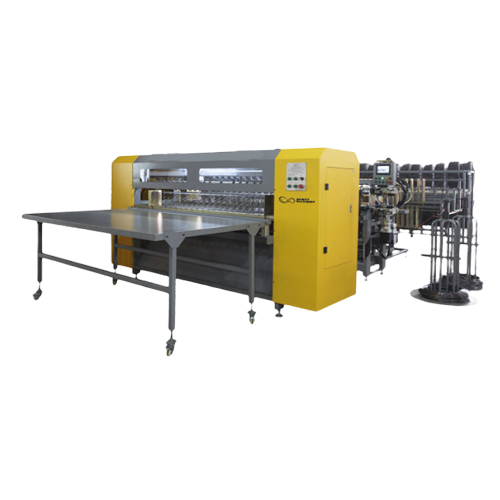
You're standing in your factory looking at an empty floor plan. You've decided to make your own spring units instead of buying them from a supplier — that decision alone will save you 35-45% per mattress. But now you face the question that every spring mattress manufacturer has to answer: bonnell or pocket spring?
It's not a trivial choice. The equipment is different. The per-unit cost is different. The target market is different. The wholesale price is different. Get it right, and your spring line runs at 40-55% margin. Get it wrong, and you've spent $80K on machines that produce mattresses your market doesn't want to buy.
This guide compares the two production lines side by side — equipment, cost, output, market demand, and ROI — using real machines from Infinity Foam Machinery. By the end, you'll know which line fits your factory, your budget, and your customers.
Before comparing equipment, you need to understand what you're actually producing. The spring type determines your target customer, your wholesale price, and your production complexity.
Bonnell springs are hourglass-shaped coils connected to each other by helical wire — the entire spring unit is one interconnected grid. When you press on one spot, the surrounding springs also compress. This is called "motion transfer." Bonnell units are cheaper to produce, durable, and dominate the budget and mid-range mattress market ($80-$250 retail). Hotels, hospitals, and contract furniture are the biggest buyers.
Pocket springs are individual coils, each wrapped in its own fabric pocket. They move independently — pressing on one spot doesn't affect the surrounding springs. This eliminates motion transfer, provides better body contouring, and commands premium pricing ($200-$800 retail). Pocket spring mattresses are the fastest-growing segment in the mattress market, driven by direct-to-consumer brands and premium hotel chains.
Here's the production difference in plain terms: bonnell springs are coiled, knotted, heat-treated, and then connected with helical wire into a unit — all in one automated flow. Pocket springs are coiled, individually wrapped in fabric, and then glued together into a unit — the fabric wrapping adds a step and requires a different machine. That's why pocket spring equipment costs more.
A complete bonnell spring line takes raw steel wire and produces finished spring units. Three machines do the entire job:
| Machine | Model | Function | Speed | Est. Cost |
|---|---|---|---|---|
| Spring coiler | IF-B90 | Coils wire into bonnell springs | 80 pcs/min | $18K-$25K |
| Spring assembler | IF-BA | Connects springs with helical wire | High speed | $20K-$28K |
| Full production line | IF-BPL100 | Wire to finished unit, fully automated | Continuous | $35K-$50K |
| Total (IF-B90 + IF-BA) | — | — | — | $38K-$53K |
You can start with the IF-B90 coiler and IF-BA assembler as a two-machine setup, or go straight to the IF-BPL100 full line which combines both functions in one continuous flow. The IF-BPL100 costs more but needs only one operator instead of two.
Pocket spring production is more complex — each spring gets individually wrapped in fabric, then the wrapped springs are glued together into a unit. The equipment costs roughly double the bonnell line:
| Machine | Model | Function | Speed | Est. Cost |
|---|---|---|---|---|
| Pocket spring coiler | IF-P130-1 | Coils + wraps each spring in fabric | CNC auto | $35K-$50K |
| Dual-wire coiler (optional) | IF-P180-2 | Dual wire for multi-zone mattresses | No compressor | $45K-$65K |
| Spring assembly | IF-PPA | Glues wrapped springs into units | High speed | $30K-$45K |
| Semi-auto assembly | IF-PA | Budget alternative to IF-PPA | Semi-auto | $15K-$22K |
| Total (IF-P130-1 + IF-PPA) | — | — | — | $65K-$95K |
The IF-P130-1 is the CNC pocket spring coiler — it coils wire and wraps each spring in fabric in one automated step. The IF-PPA takes those wrapped springs and assembles them into mattress-sized units. If budget is tight, the IF-PA semi-automatic assembler costs half as much but needs an extra operator.
Equipment cost is only half the picture. What matters is the per-unit production cost and how long it takes to recover your investment. Here's a side-by-side comparison for a factory producing 300 spring mattresses per month:
| Metric | Bonnell Line | Pocket Spring Line |
|---|---|---|
| Equipment investment | $48K (IF-B90 + IF-BA) | $80K (IF-P130-1 + IF-PPA) |
| Wire cost per unit | $1.80 | $2.20 |
| Fabric + glue per unit | $0.00 | $0.90 |
| Labor per unit | $0.30 | $0.40 |
| Total per-unit cost | $2.10 | $3.50 |
| Vs buying from supplier | $5.20 (save $3.10) | $8.50 (save $5.00) |
| Wholesale price (mattress) | $45-$55 | $65-$95 |
| Monthly savings (300 units) | $930 | $1,500 |
| Monthly margin advantage | Baseline | +$6,000-$12,000 |
| Payback period | 8-10 months | 10-14 months |
The bonnell line is cheaper to set up and pays back faster. But the pocket spring line generates significantly more revenue per mattress — the wholesale price premium of $20-$40 per unit dwarfs the extra $1.40 per-unit production cost. At 300 mattresses per month, pocket springs generate $6,000-$12,000 more in monthly gross profit.
The question is not which line is "better." It's which line fits your market.
1. Who are your customers?
If you sell to hotels, hospitals, government contracts, or budget furniture stores — bonnell. These buyers need durable, affordable mattresses and don't care about motion isolation. If you sell to premium retailers, direct-to-consumer brands, or high-end hotels — pocket spring. These buyers want the "no motion transfer" story and will pay for it.
2. What's your retail price point?
If your mattresses sell for under $250 retail — bonnell. The margin works. If you're targeting $300+ retail — pocket spring. The premium pricing covers the higher production cost and then some.
3. What's your startup budget?
Under $60K for spring equipment — bonnell (IF-B90 + IF-BA). $80K+ available — pocket spring (IF-P130-1 + IF-PPA). If you have $120K+, consider the IF-P180-2 dual-wire pocket spring machine for multi-zone mattresses — it's the premium option that targets the highest-margin market segment.
4. What does your competition sell?
If every factory in your region makes bonnell mattresses, the market is probably price-competitive and margins are thin. Pocket spring production lets you differentiate. Conversely, if your market is already saturated with pocket spring brands, a bonnell line targeting the underserved budget segment might be more profitable.
5. Do you need to ship mattresses flat or rolled?
Both spring types can be roll-packed with a roll packing machine, but pocket spring units compress more uniformly and recover their shape better after unrolling. If e-commerce is your primary channel, pocket spring gives better customer satisfaction on unboxing.
Yes — and this is what the most profitable mattress factories do. A dual-line factory can serve both budget and premium markets from the same floor. The combined equipment investment is $110K-$145K, but the revenue diversification is worth it: when hotel contracts slow down, retail pocket spring orders pick up the slack.
The trick is sequencing. Start with the line that matches your current customer base. If you already sell bonnell mattresses, start with the IF-B90 + IF-BA bonnell line. Once that line is profitable (typically 8-10 months), add the IF-P130-1 pocket spring coiler to enter the premium market. The bonnell profits fund the pocket spring expansion.
One thing to consider: the IF-L wire drawing spring machine produces continuous spring units — a third option that sits between bonnell and pocket spring in both cost and quality. It's worth considering if you make sofa springs or furniture cushions alongside mattresses.
Spring production is one stage of mattress manufacturing. Regardless of which spring line you choose, you still need the same downstream equipment:
The spring line choice only affects the coiling and assembly stages. Everything else — quilting, tape edging, packing, foam cutting — is shared. That's why starting with one spring type and adding the other later is practical: you're only buying the coiling and assembly machines, not a whole new production line.
| Factor | Choose Bonnell If... | Choose Pocket Spring If... |
|---|---|---|
| Budget | Under $60K | $80K+ |
| Retail price | Under $250 | $300+ |
| Target customer | Hotels, hospitals, budget retail | Premium retail, DTC brands |
| Payback speed | 8-10 months | 10-14 months |
| Per-unit margin | Lower, higher volume | Higher, lower volume |
| Market growth | Stable, mature | Growing 12%+/year |
| Production complexity | Simpler, fewer steps | Fabric wrapping adds a step |
| Best starting point | IF-B90 + IF-BA | IF-P130-1 + IF-PPA |
Still not sure? Here's the simplest decision rule: if your current customers are asking for cheaper mattresses, build a bonnell line. If they're asking for better mattresses, build a pocket spring line. If you're not sure what they want, call them and ask — the answer will tell you which line to build.
And if you want help running the numbers for your specific factory — your output target, your current customer base, your available space — tell us what you're working with. We design spring production lines for factories across 30+ countries, and we can tell you exactly which configuration fits your situation and how fast it pays back.
Tell us your customers, your budget, and your target price point. We'll design the right spring line and calculate your ROI — free, no obligation.